Staging a Non-Intervention


I am a rabid interventionist.
I’m not referring to my views on foreign policy — I am talking about the very fiber of my being. When I see something wrong, my instinct is to step in and fix it. My first career in ministry addressed people’s spiritual problems. My second career as a management consultant for nonprofits targeted organizational dysfunction. And my third career as a public theologian with Good Faith seeks to improve the ways Christians engage the broader world.
In my relational life, I can’t stand unresolved conflicts, and will generally tackle them head on. I can’t abide suboptimal storage arrangements; my idea of a fun afternoon is to browse the aisles of The Container Store for inspiration. By day, I religiously follow workout plans that target physical problems; by night, I seek to stave off tooth decay with what I call “my dental liturgy:” floss, water pick, a smart electric toothbrush, mouthwash, and a nighttime mouth guard as “amen.”
All of which is why I get rather irritated by Jesus’ Parable of the Weeds.
In Matthew 13:24-30; 36-43, Jesus tells a story where there is a clear problem: an enemy has sown weeds into a master’s field. His servants propose to enact an immediate solution (as well they should!). They want to go dig out those weeds (of course!). But the master tells them to hold off.
Why? Anyone with a garden knows that weeds need to be rooted out quickly before they spread. Why does the master prevent a perfectly logical and necessary intervention?
This parable is odd because Jesus often commands intervention to his followers. In just a few passages after the Parable of the Weeds (14:16), Jesus tells his disciples to respond to the plight of the hungry crowds. He previously instructed them to “heal the sick and raise the dead” (10:8). In fact, Jesus’ message of non-intervention here goes against a core personality trait that Jesus sought in all his disciples. After all, every single one of them said“yes” to Jesus’ call to “come and follow me,” a decision that meant radically reorganizing their lives (4:19).
The Parable of the Weeds puzzles followers of Jesus who congenitally lean towards activism. I think this is why, after Jesus goes on to teach two other parables of the Kingdom, the disciples essentially say, “Um, can you go back to that story about the weeds — that’s the one that confuses us!” (13:36).
How are you supposed to know when to act decisively and when to hold off?
A parable is not meant as a step by step instruction pamphlet, nor is any one parable meant to apply to all situations. The confusing and idiosyncratic nature of a parable like this one is the point: the confusion jars us from our ingrained instincts and the idiosyncrasy forces us to consider which particular situations are relevant. This process is how wisdom grows.
I think the parable suggests that the interventionist instinct ought to be questioned in three kinds of situations, defined by how much we feel judgmental, impatient, and anxious.
Feeling judgmental
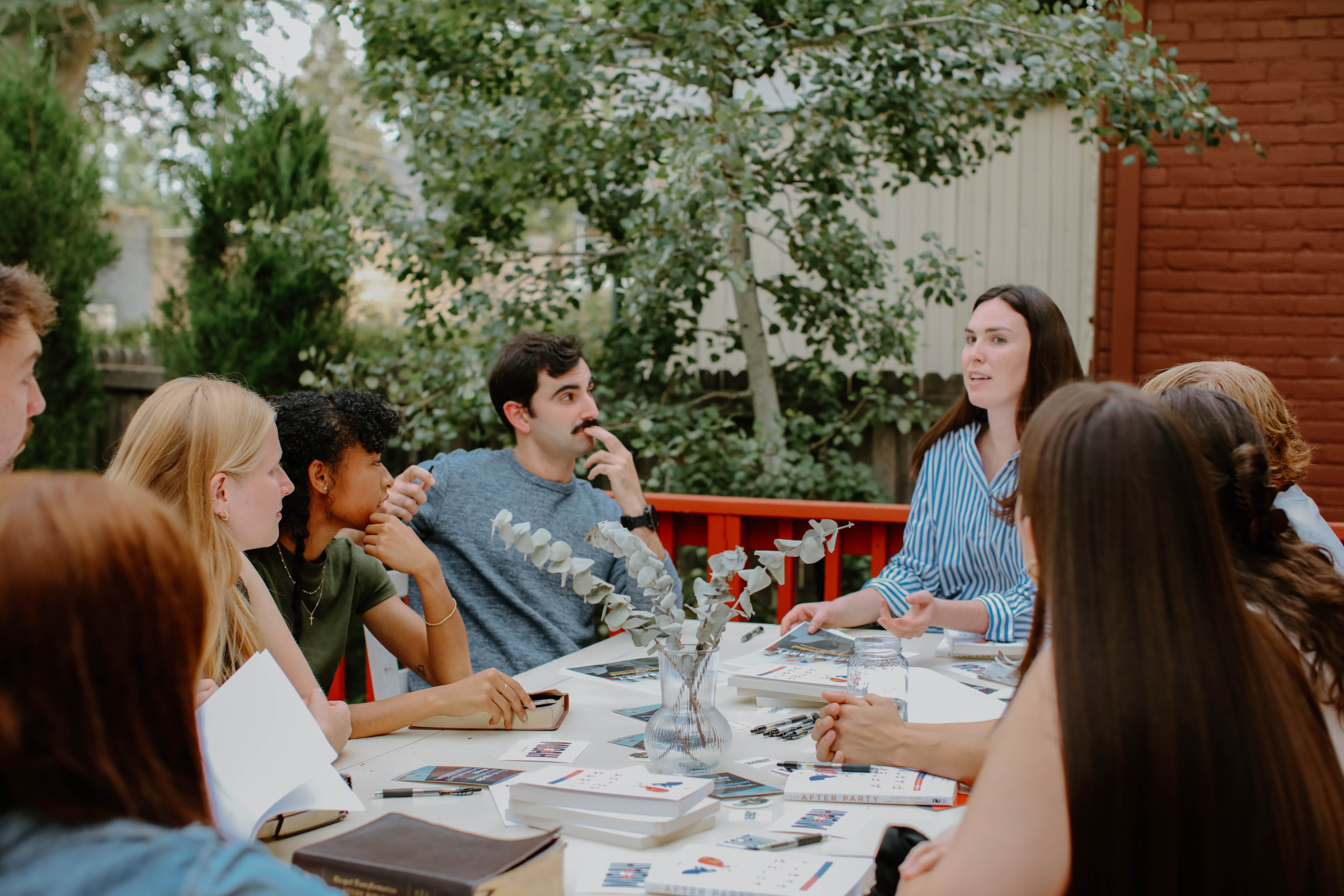
There is a difference between “exercising judgment” in the sense of diagnosing a problem and “feeling judgmental” in the sense of declaring another person (or persons) is THE problem. We launched The After Party project precisely to help all of us make this wise distinction in the realm of politics. Judging that certain policies are wrong is quite different from believing one party is the embodiment of evil itself. The Parable of the Weeds recognizes that there are indeed people who act as “bad seeds,” behaving in ways that resist the Kingdom; they may in fact may be under the influence of the devil “who sows the bad seed” (v. 38-39). But to be a person currently influenced by the devil is not at all the same as being the devil. The distinction between the sower (the devil) and the seed (the person) matters. The sower, not the seed, is the real cause. Jesus’ explanation of the parable emphasizes that God’s judgment will ultimately get at the roots, the “everything that causes sin” (v. 41). Only then will God reveal – and deal with – those people who have given themselves entirely and permanently over to the causes of evil.
One present implication of this piece of wisdom is that we should ask ourselves, “Is my intervention rooted in confidently pinning all blame on a person (or persons), or does it recognize deeper roots that require more discernment?” An important value of holding off a rash intervention is allowing more time for us to conduct this kind of deeper investigation. And in my experience, doing this often gives room for the Spirit to prompt my own capacity to extend grace to the person(s) involved.
There’s another reason to refrain from pointing a finger entirely at another: as that old saying goes, “when you do so, there are three pointing back at you.” Part of the problem may reside within us, no matter how “absolutely right” we consider ourselves. The parable is warning that at an existential level, the good and the bad are mixed together, so much so that it’s likely that “in gathering up the weeds, you would uproot the wheat with them” (13:29). People will be judged by God in the “final harvest” in an appropriate fashion. But we are not qualified for that job.
Feeling impatient
Obviously, there are crisis situations that call for immediate intervention. Hypothetically, if I am suffering a heart attack, I want my doctor to do something STAT! But what if I have a condition known as mitral valve regurgitation, as I do in fact have?” When I received this diagnosis, my first instinct was to immediately seek a surgical fix. But my cardiologist, who is one of those older doctors who radiates a calm wisdom, eventually convinced me to wait. The specifics for this particular decision aren’t important; the point is that the proper response to some problems is patience.
And that is also the point of the two parables nestled between the original telling of the Parable of the Weeds and the disciples’ request for an explanation. The Parable of the Mustard Seed and the Parable of Yeast are both about refraining from demanding an immediate result: the tree and the bread both require time to come into being, and we must nurture our capacity to wait.
Each of our own situations requires discernment on whether waiting is indeed the best response; but for interventionists like me, just considering this option is a first step towards greater wisdom. Waiting to act on our own gives room for God to act. And those two parables suggest that the Kingdom of God has his own timetable, one that is often slower than we would like.
Why might God have a bias towards moving slowly? I think the answer starts with the reality that while a problem in this world should not be reductively equated to a person as the sole cause, there almost always are people involved. Human beings are entangled in what goes wrong. However, the agricultural metaphor for people in the Parable of the Weeds reminds us that people are not static: they can grow into something better. The two ensuing parables remind us that the Kingdom God works within people so that they grow organically, not simply in response to some external intervention. Other human beings grow and improve slowly; and if we are being honest, so do we.
In a real sense, God cares more about growing people than fixing problems in the world. Or put slightly differently, God wants to fix problems in the world through people… and that takes time.
This truth has all sorts of implications for leaders seeking to bear God’s image in their work. Henri Nouwen coined a lovely phrase for this kind of leadership: “the ministry of absence.” Refraining from stepping in opens up space for others to step up. I am admittedly terrible at this kind of ministry. But I’m grateful that God will patiently give me time to get better.
Feeling anxious
Finally, we would be wise to discern the presence of anxiety in our interventions. Anxiety is the voice warning us, “Act now or you will experience a devastating and permanent loss!” And therein lies the interventionist’s greatest vulnerability: we believe that we can decisively avoid such a loss. Anxiety is a tell tale sign that this belief animates our interventions.
As I wrote in my book The Anxiety Opportunity, this belief is simply false. We cannot avoid loss. We might be able to step in to delay certain losses from happening now, but loss comes for us all because death – the Loss of all losses – comes for us all. Ultimately, we cannot avoid loss via our interventions. The more we mistakenly think that we can avoid loss, the more anxiously we will pursue more and more interventions. Like those aging Hollywood stars who keep “getting work done” on their face until they become grossly disfigured, we end up deforming our true nature.
And what is our true nature? We are beings that inevitably will face loss. Jesus elsewhere uses the metaphor of the “harvest” of seeds only occurring after death. “The harvest” requires that the crop loses its life (John 12:24). But a seed that must be buried in the ground is not lost permanently. If we wait patiently, the buried seed undergoes a profound transformation. In the big story of the Kingdom, the Harvest leads to the Feast: when God gathers all that was lost and resurrects them to Life everlasting. This is the full picture of the “end of the age” in the Parable of the Weeds (Matt. 13:40). The end of the parable points towards this ultimate end. And similarly, all human interventions can only be engaged as temporary signposts to that Final Intervention.
Our personal and public spheres are beset with all sorts of feared losses. We ought to ask God’s Spirit to guide us towards the appropriate interventions. But let us remember that the most well-resourced, smartly designed, urgently enacted, and even wisely discerned interventions are at best, temporary pointers over the horizons of human history, until the Son of Man finally enables us to permanently “shine like the sun in the kingdom of the Father” (v. 43). This climax of history is the final age of shalom, a permanent and settled peace. Thus, in this age, our own sense of peace amidst our activism is an important indicator that we are indeed pointing towards that ultimate destination.
May the Kingdom come — and may we work towards that day with grace, patience, and peace.

Get the latest insights and updates delivered straight to your inbox weekly.